

News / 26 April 2026
Weekly Review: U.S. Resilience Persists Despite Rising Pressures
U.S. retail sales rose 1.7% in March, marking the strongest monthly increase since early 2023, largely driven by a 15.5% surge in gasoline station sales. Excluding this category, sales still increased a solid 0.6%, while control group sales (which feed directly into GDP) advanced 0.7%. Upward revisions to January and February data suggest that underlying economic activity was firmer than initially estimated over the first quarter.
U.S. business activity gained modest momentum in April after nearly stalling in March, although supply-side pressures intensified as factory delivery times lengthened amid disruptions linked to the Iran conflict, pushing output prices to a near four-year high. S&P Global’s flash U.S. Composite PMI rose to 52.0 from 50.3. Consumer sentiment, however, remained subdued. The University of Michigan Index of Consumer Sentiment declined by 3.5 points to 49.8, with weakness broad-based across demographics. Inflation expectations moved higher, with one-year expectations rising to 4.7% from 3.8% and long-term expectations increasing to 3.5%, the highest level since October 2025.
EUROPE & UK
Eurozone business activity contracted in April, with the escalation of the U.S. conflict with Iran weighing on demand and contributing to rising price pressures. S&P Global’s Flash Eurozone Composite PMI fell to 48.6 from 50.7, well below expectations and signalling contraction, while supply shortages continue to build, adding pressure to both growth and prices.
In contrast, the UK saw an uptick in business activity, with the Composite PMI rising to 52.0 from 50.3, above expectations. This was accompanied by input costs rising at the fastest pace on record. UK retail sales rose 0.7% month-on-month in March, exceeding expectations, driven by fuel and non-food spending. Despite this, consumer sentiment deteriorated, with the GfK Consumer Confidence Index falling to -25 in April, the lowest level since October 2023.
ASIA
Japan’s latest inflation data suggests that the impact of the Middle East conflict is beginning to filter through to the broader economy. Core CPI rose 1.8% year-on-year in March, ahead of expectations, driven by higher energy costs, although government subsidies provided some offset.
Separately, Xi Jinping called for an immediate ceasefire between the U.S. and Iran and the reopening of the Strait of Hormuz in a call with Mohammed bin Salman.
GLOBAL EQUITIES
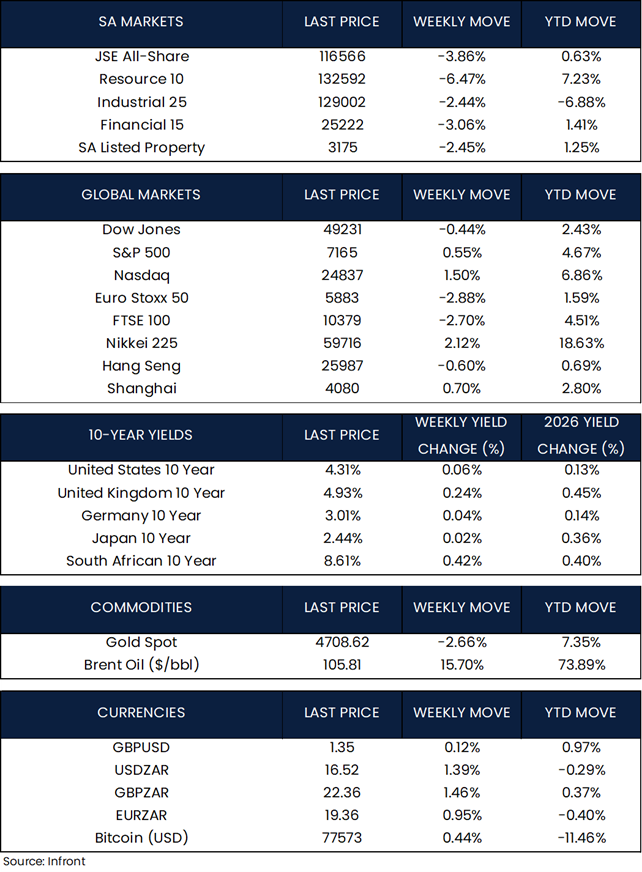
Most major U.S. equity indices ended the week higher, with several reaching record highs, as broadly positive economic data, continued strength in artificial intelligence (AI)-linked stocks, and supportive earnings helped offset ongoing uncertainty surrounding the U.S.–Iran conflict. The technology-heavy Nasdaq Composite led gains, rising 1.50%, followed by the S&P 500, which advanced 0.55%. The Dow Jones Industrial Average, however, declined 0.44%. Oil prices, which have been closely monitored amid the conflict, surged 15.70% over the week to close at $105.81 per barrel.
The pan-European STOXX Europe 50 Index ended the week down 2.88% in local currency terms, while the UK’s FTSE 100 declined 2.70%.
In Asia, Japan’s Nikkei 225 gained 2.12%, extending its record highs, supported by strong performance in technology and AI-related stocks despite ongoing uncertainty around the Middle East conflict. Mainland Chinese equities were broadly stable, consolidating gains from the prior week’s stronger-than-expected economic data amid a limited pipeline of new domestic catalysts, with the Shanghai Composite Index edging up 0.70%. In contrast, Hong Kong equities underperformed, with the Hang Seng Index declining 0.60%.
Market Moves of the Week:
South Africa’s headline CPI rose to 3.1% year-on-year in March, up from 3.0% in February, according to Statistics South Africa. Price pressures broadened, with 6 of the 13 CPI categories recording higher annual inflation, including housing and utilities, transport, restaurants and accommodation, and education. The March print did not yet reflect the impact of higher oil prices linked to the Middle East conflict, which is expected to filter through in April.
Local equity markets declined over the week, as elevated geopolitical tensions and higher oil prices weighed on sentiment. The JSE All Share Index fell 3.86%, with broad-based weakness across sectors. Resources led the decline, falling 6.47%, followed by Financials (-3.06%), Industrials (-2.44%), and Listed Property (-2.45%). The rand ended the week 1.39% weaker against the U.S. dollar, closing at R16.52 on Friday.
Chart of the Week:
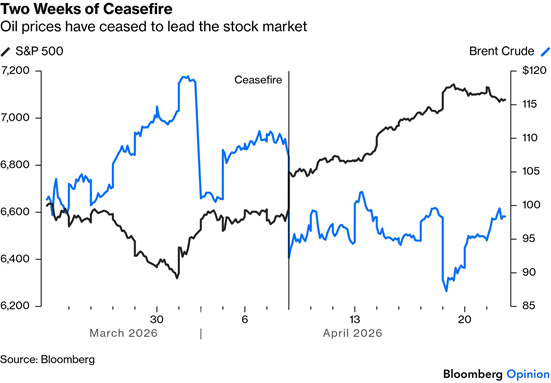
Crude oil prices surged, with Brent topping $100 for the first time in seven trading days. However, the typical inverse relationship between oil prices and U.S. equities has not held since the pause in hostilities two weeks ago. Despite ongoing disruptions, including the continued blockage of the Strait of Hormuz and stalled peace talks, the rise in crude over the week coincided with gains in U.S. equities.
Credits: Strategiq Capital


